
Based on my experiences of fell races, I have compiled a list of things which may be useful to know before heading to your first race...
Finding a race local to you:
In order to find out about local races, the internet is a good place to start, especially if you are an "unattached" runner (not a member of a running club). The Fell Runners Association (FRA) is a good site. I would recommend joining a local club as running in a club vest is a great feeling when other members cheer you on, and you often get discount at bigger events.
In general, fell running is a pretty simple sport with minimal kit requirements, however, there is a definite winter/summer divide and weather obviously plays the main part in choosing what kit to wear and when.
 |
| Wearing a jacket in cold and windy conditions |
Winter Kit Suggestions:
- A head cover - hat/buff/headband (I prefer a buff or headband to cover my ears, which lets heat escape from the top of my head, I guess if you are a bit "thin on top" you may prefer a hat!)
- Gloves - you can get waterproof gloves but I find my hands soon warm up so I wear basic thin running ones and usually end up taking them off mid-race
- Base layer top with long sleeves
- Technical Tee (never wear cotton as it soaks up sweat then chills to the bone)
- Race vest (if member of a club)
- Long running tights (with a drawstring waist)
- Wool or wool blend socks
- Fell shoes with good grip (very very important) I use the Inov-8 mudclaws but try Walsh or Salomon for other popular choices
- Jacket - a waterproof (with taped seams), windproof and breathable jacket or smock like the OMM Kamleika is highly recommended and actually a necessity if running under "full kit" rules (more about this later)
Summer Kit Suggestions:
 |
| Buxton Carnival Race - Summer kit |
- A cap, visor or sunglasses (or just a thin headband to keep flyaway hair out of your face if it's long - you can get 1cm wide bands with silicone grips on the back which are good)
- Technical Tee (may not be required if it's a warm day but handy to take just in case)
- Race vest
- Shorts, short tights or 3/4 length tights
- Thin running socks
- Fell or Trail shoes dependent on conditions and terrain
 |
| Lambs Longer Leg in the snow - Wearing a hydration vest |
- For longer races - A hydration vest like one pictured in the Lambs Longer Leg race
- For short races a water bottle with loop for hand will be fine (I often don't carry any water for short races less than 10 miles)
- A bladder system can be used if a backpack needs to be worn e.g. if full kit is required to be carried see the Phantom 12 from OMM
- GPS watch I use a Garmin Forerunner 220 or a Garmin Vivoactive HR
- Vaseline - thin layer between the toes
- Suncream stick
- 4 x safety pins (usually provided at registration) or a triathlon belt to hold race number in place
 |
| Spring racing |
A set of runners rules is here. It often states that, "competitors must be prepared to carry full kit" in order for the organisers to cover themselves for insurance purposes.
It is always worth taking a backpack with a map of the route (usually available online), hat, gloves, compass, whistle, water, sweet snack or gel (jellybabies are very popular, I prefer jellybeans!) and full body cover (a waterproof jacket and waterproof trousers (both with taped seams) with you to fell races, just in case you are made to carry them.
Generally, you don't need to if the race is in the short category, and it is left to the runners discretion but do bear in mind that, if you are going up high - the weather may change and you may need a jacket for example, as a bare minimum. My jacket has actually proved to be a helpful aid as I was literally blown by the wind past three other runners in the Famous Grouse fell race last year!
It is worth having a read of the following links just in case you get into difficulties or encounter another runner in trouble (it is compulsory to help another runner if you find them in a poor condition, regardless of the fact you are racing).
 |
| Windy at the summit - jacket and headband needed! |
Hypothermia info
Hypoglycemia info (low blood sugar)
Dehydration info
Race Abbreviations
When I first started to look for fell races, I was baffled due to the abbreviations used - as there are 2 letters describing each race.
The first is A, B or C and shows the average height gain per mile.
A = Really Steep! (Think near vertical hills and using your hands to help!)
B = Quite steep
C = Not really that steep
The second letter used is S, M or L and shows the length of the race:
S = Short less than 10k
M = Medium 10 - 20k
L = Long 20k +
 |
| A steep climb! |
Ultras are races longer than marathon distance (eek!)
Other abbreviations are:
'ER' = experience required.
'LK' = local knowledge an advantage.
'NS' = navigational skills required.
'PM' = course partially marked.
I have never had to read a map or use any navigational skills in any of the races I have done, I think that the chances of me being at the front are very slim and generally, I can see other runners as I am mid-field. That said, it would obviously be useful to have a map and compass just in case, and know how to use them! It's the sort of thing you make the call on, on the day.
What to expect on the day -
Weather is never permitting in this sport! Fell races are not weather dependent - they are always going to be run, if you can get there, it will be on! This is not a sport for softies, if its snowing, so what? Actually, running in the snow is quite cool (yes, literally!).
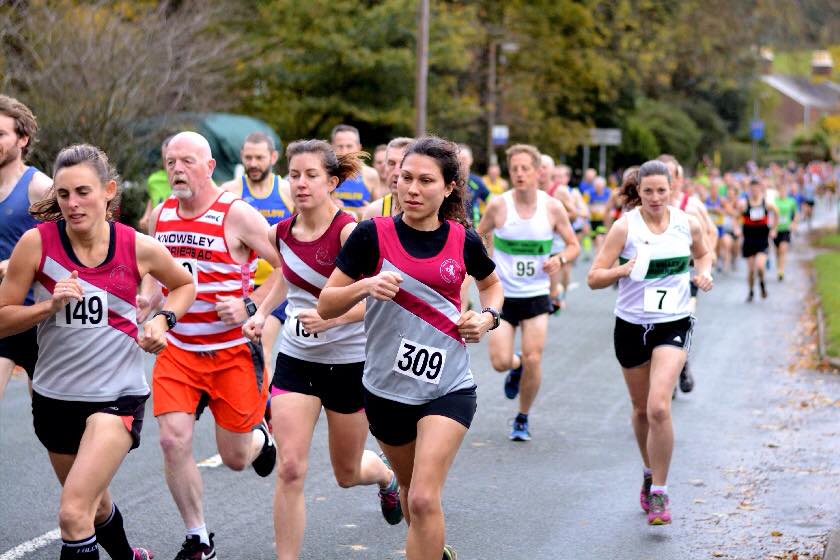
Fell running has a mid-week season, starting in Spring, with races held at around 7-7.30pm on Wednesday evenings (not always but in general). You literally just turn up (unless the event is pre-entry only which would be quite unusual) - it's worth car sharing if possible, as parking is normally limited, pay a really nominal fee (my last race entry was £3), fill in a form, attach your number to your front, head to the start area, listen to the briefing and off you go! It's all very low-key and friendly. When you have finished the prize giving is usually quite quick, and it's nice to stay and support who won etc. but if you have to dash home the results are usually available in the next couple of days online.
There are usually a lot more male runners than females, and the results can be a bit baffling, with different age categories.
Usually, there are the following categories:
MU23/FU23 (Male/Female Under 23 Years)
M/F(Male/Female between 24 - 39)
MV40/FV40 (Male Veteran 40 aged between 40 and 44)
and so on with ...
MV45/FV45 etc. up to the 80's! Sometimes, the increments are 10 year and not 5 year ones, but it depends on the race and the association etc.
And that's it! The main thing is to start off with the fairly short B races, as the AS ones are really tough - even though they are short. Try to go with someone else, even if you don't run at the same pace, car sharing and post race blow by blow accounts are all part of the fun!
Remember, it may feel like the worst thing you have ever done at the time (!), but that good old "run-esia" (run amnesia) will kick in after and you will only remember the achievement and I promise you will want to do it again!
Happy Fell Running!
TLF x
Weather is never permitting in this sport! Fell races are not weather dependent - they are always going to be run, if you can get there, it will be on! This is not a sport for softies, if its snowing, so what? Actually, running in the snow is quite cool (yes, literally!).
Fell running has a mid-week season, starting in Spring, with races held at around 7-7.30pm on Wednesday evenings (not always but in general). You literally just turn up (unless the event is pre-entry only which would be quite unusual) - it's worth car sharing if possible, as parking is normally limited, pay a really nominal fee (my last race entry was £3), fill in a form, attach your number to your front, head to the start area, listen to the briefing and off you go! It's all very low-key and friendly. When you have finished the prize giving is usually quite quick, and it's nice to stay and support who won etc. but if you have to dash home the results are usually available in the next couple of days online.
There are usually a lot more male runners than females, and the results can be a bit baffling, with different age categories.
 |
| A fellow Goyt Valley Strider from the MV50 category - Pete Ambrose finishing the Thomas Theyer fell race in April |
Usually, there are the following categories:
MU23/FU23 (Male/Female Under 23 Years)
M/F(Male/Female between 24 - 39)
MV40/FV40 (Male Veteran 40 aged between 40 and 44)
and so on with ...
MV45/FV45 etc. up to the 80's! Sometimes, the increments are 10 year and not 5 year ones, but it depends on the race and the association etc.
 |
| One of the best things about fell running... |
Remember, it may feel like the worst thing you have ever done at the time (!), but that good old "run-esia" (run amnesia) will kick in after and you will only remember the achievement and I promise you will want to do it again!
Happy Fell Running!
TLF x


